


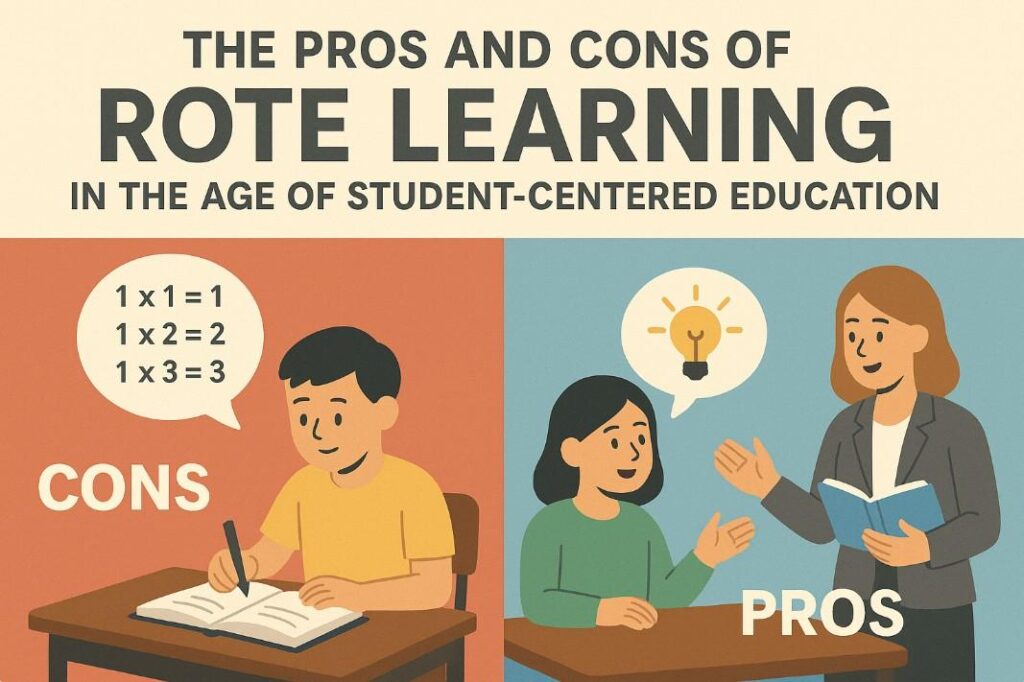
Education has undergone more change in the past twenty years than in the whole previous century. From blackboards to smart classrooms, from thick textbooks to engaging apps, learning for students today is vastly different from what it was like in the past. However, one technique continues to be controversial among parents and teachers: Rote Learning.
It is the age-old process of learning from memory by repetition, with little comprehension of the topic in the process. While Student-Centered Learning is presently the in-thing in contemporary education, Rote Learning still has a presence in the classrooms of the globe. The question is, however, should it?
Let’s break down what it really means, why it still exists, and how it compares with today’s student-first teaching methods.
What Is Rote Learning?
It means learning something by repeating it many times until you remember it.
For example:
- Memorizing multiplication tables
- Remembering the names of countries or states
- Learning spellings or grammar rules
It is like practicing the same thing again and again until it sticks in your mind. But you may remember it, but you might not fully understand it.
Why It Still Exists
Even though new teaching styles have arrived, This Learning is still used because:
- It helps students remember facts quickly.
- It’s easy to test through written exams.
- It builds focus and discipline.
So while it’s not perfect, it still has some good sides.
The Pros of Rote Learning
Let’s look at where this actually helps.
-
Builds Strong Memory
Repeating something several times helps your brain store it for later. That is why students who memorize tables or formulas can recall them quite quickly at the time of giving exams.
-
Creates a Base for Advanced Learning
Before students can solve complex problems, they must know the basics.
For example:
- You have to learn your times tables before you learn algebra.
- You have to know the alphabet before you are able to read words.
-
Helps in Exams
Most exams still depend on correct answers, not on how creatively you write them. It is better when you memorize important points, formulas, and dates.
-
Improves Focus and Discipline
Repeating and writing something again and again requires patience. It helps build focus, an important skill not just in studies but in life too.
-
Works for All Ages
You can use this learning at any age. It enhances memory power whether you are a child who is learning the spelling or an adult who is learning a new language.
The Cons of Rote Learning
Now, let’s talk about what doesn’t work so well with this method.
-
You Remember, But Don’t Understand
When you memorize something without knowing what it means, it’s easy to forget later.
Example: It is very easy to forget what one has memorized if he does not understand the meaning of what he is trying to remember.
-
It Kills Curiosity
If students are told to just memorize and repeat, they stop asking “why.” Learning becomes mechanical, not interesting.
-
Short-Term Knowledge
You may remember things for an exam, but forget them soon after because there’s no deep understanding.
-
No Room for Creativity
Learning does not encourage imagination or problem-solving. Students may struggle to think independently.
-
Causes Stress
It can be exhausting and stressful to memorize a lot of information. Other students are nervous that they may forget the things that they have studied.
What Is Student-Centered Learning?
Let’s now talk about a newer and better approach to Student-Centered Learning. This approach concentrates on not what the students need to memorize but how they learn most effectively. It encourages students to explore, ask questions, and make connections between the lessons, and real life, etc.
In Student-Centered Learning:
- The teacher acts as a guide, not a strict instructor.
- Students take part in discussions and activities.
- Learning is interactive and practical.
At Dr. Kishore’s Ratnam School, this method is already in action. Teachers rely on activities, group work and real world examples so that students do not learn the topics by heart, but rather know them well.
Rote Learning vs. Student-Centered Learning
Here’s a simple comparison:
| Feature | Rote Learning | Student-Centered Learning |
| Focus | Memorizing facts | Understanding concepts |
| Learning Style | Repetition and recall | Exploration and discussion |
| Teacher’s Role | Main speaker or authority | Guide and mentor |
| Student’s Role | Passive listener | Active participant |
| Best For | Basic knowledge and facts | Concept understanding and creativity |
Both have their value; the trick is knowing when to use which.
When This Learning Works Best
Rote Learning can be helpful when:
- You need to memorize facts, formulas, or vocabulary.
- You’re learning the basics of a new subject.
- You need to prepare for exams that require direct answers.
For example:
- Learning times tables
- Remembering historical dates
- Memorizing grammar rules
It’s like learning the ABCs before writing stories, necessary, but not the final goal.
When Student-Centered Learning Works Best
This learning shines when:
- You want to understand “why” something happens.
- You need to solve real-life problems.
- You’re working in groups or on projects.
For instance:
- Doing science experiments
- Discussing current events in social studies
- Solving math puzzles with your classmates
This kind of learning builds critical thinking and confidence, two skills that matter most in the real world.
How to Balance Both Methods
The smartest way to learn is to mix both approaches. Here’s how teachers and students can do that:
-
Start with Rote Learning
One of the ways will be using repetition to learn and remember basic facts, terms, and formulas.
-
Then Move to Student-Centered Learning
After you have the basics, learn from meaning-oriented discussion, examples, and practical work
-
Connect Knowledge to Real Life
Teachers can show how classroom lessons apply in daily life, for example, using math to budget pocket money or science to understand cooking.
-
Encourage Questions
Students should be free to ask “why” and “how.” This helps them think beyond memorization.
-
Review and Reflect
Instead of repeating blindly, revisit what you had learned and describe it in your own words..
At Dr. Kishore’s Ratnam School, this balance is part of the teaching style. Students are encouraged to first build their base knowledge through this learning and then expand it through projects, teamwork and real world problem solving. This way, they remember better and understand better.
Why This Balance Matters
The future belongs to students who can think, adapt and create, not only memorize. While that said having a strong memory would make learning fast and easy.
That’s why schools need to find a middle path:
- Use Rote Learning for quick recall.
- Use Student-Centered Learning for deep understanding.
Both prepare students not only for exams but for life.
Final Thoughts
In the end, Rote Learning is not bad. It is just incomplete on its own. It helps you remember, but not always understand.
This is a part of Student-Centered Learning. Let’s make the connection between facts and real meaning; let’s get you ready for a future where thinking will matter much more than memorizing.
When both methods are used, students learn more quickly, retain what they have learned longer, and enjoy the learning process much more. And the true goal of education is not to fill minds with facts, but to light them up with curiosity.