


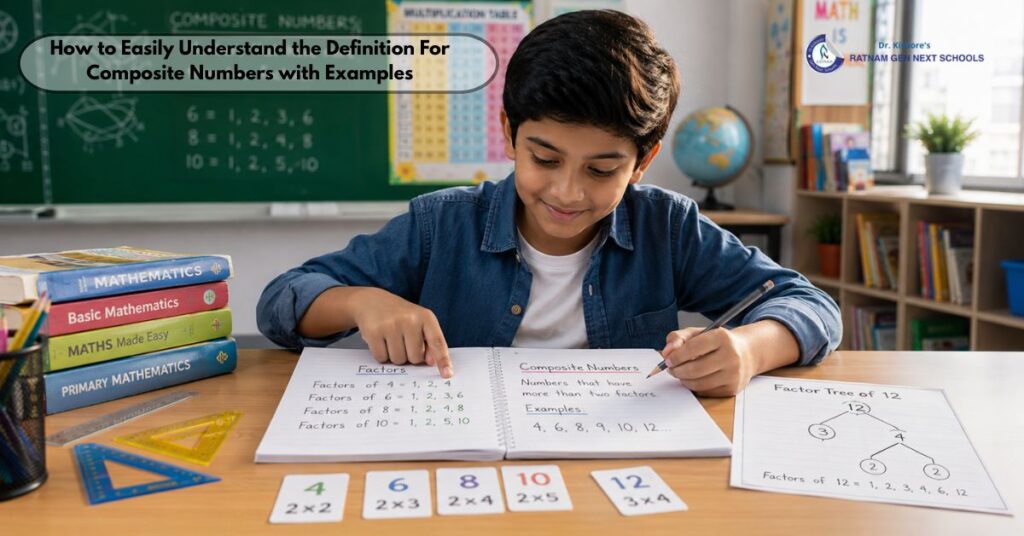
It can be difficult for some children to understand mathematics, especially when introducing new terms like prime and composite numbers. But the moment one explains the concept to them, everything becomes much easier.
One of the topics that most children study at primary-level schools is the concept of composite numbers. In the case of Dr. Kishore’s Ratnam Schools, teachers feel that children grasp mathematical concepts easily when taught in a clear and straightforward manner. Here is an explanation of composite numbers in the simplest way possible.
What Is the Definition For Composite Numbers?
A composite number is a number having more than two factors.
Here you must be thinking, what do we mean by factors?
Factors refer to numbers that can divide any number completely without leaving a remainder.
For instance,
The factors of 6 are,
- 1
- 2
- 3
- 6
As 6 has more than two factors, thus it is known as a composite number.
This is what a composite number means.
Or more clearly put, when a number has other numbers by which it can be divided apart from itself and one, then such a number is said to be a composite number.
Understanding with a Simple Example
Take, for example, the number 8.
Its factors include:
- 1
- 2
- 4
- 8
From this, we see that since 8 has more than two factors, then it qualifies to be called a composite number.
Take another number, for example, the number 7.
Take another number, for example, the number 7.
The factors of 7 include:
- 1
- 7
This number has two factors, therefore making it a non-composite number; a prime number.
Many students tend to struggle in such situations, but once you know the factors, then everything becomes easy.
Easy Trick to Identify Composite Numbers
Here is a simple way children can check whether a number is composite.
Ask these questions:
- Can the number be divided by numbers other than 1 and itself?
- Does it have more than two factors?
In case the answer is yes, it means that it is a composite number.
For instance:
- 4 – divisible by 2
- 6 – divisible by 2 and 3
- 9 – divisible by 3
- 10 – divisible by 2 and 5
All these are composite numbers.
Difference Between Prime and Composite Numbers
Students often mix up prime numbers and composite numbers. So let’s understand the difference in a simple table.
| Prime Numbers | Composite Numbers |
| Have exactly 2 factors | Have more than 2 factors |
| Divisible only by 1 and itself | Divisible by other numbers too |
| Examples: 2, 3, 5, 7 | Examples: 4, 6, 8, 9 |
For instance:
- 5 can be factored by 1 and 5 only – Prime number
- 8 has factors 1, 2, 4, and 8 – Composite number
After this concept is grasped, the subject will become easy for them.
Is 1 a Composite Number?
This is a very common question raised by students.
The answer to this is no.
The factor of 1 is 1 itself.
The composite number must have a minimum of three factors.
Consequently, 1 cannot be either a prime number or a composite number.
This minor point is very crucial, since many students make the mistake of considering 1 to be a prime number.
Why Learning Composite Numbers Is Important
Composite numbers are a basic part of mathematics. Students use this concept later in:
- Multiplication
- Division
- Fractions
- Factors and multiples
- Algebra
If children understand these basics properly, higher-level math becomes much easier.
That is why strong conceptual learning matters during the early school years.
In the institutions of Dr. Kishore’s Ratnam Schools, students are motivated to comprehend ideas than merely memorize equations, thus making them amongst the most desired schools in Tirupati for laying a solid educational foundation.
Fun Ways Children Can Practice Composite Numbers
Mathematics learning gets simpler for kids through games and other activities.
Here are some easy methods that parents and teachers can employ:
Sorting Numbers
Write numbers between 1 to 20 and let the kids sort out primes and composite numbers.
Game of Factors
Select a number and get the kids to determine all its factors.
Skip Counting
Learn multiplication tables as they will make it easy to recognize composite numbers.
Use Daily Objects
Make use of chocolates, pencils or toys to show the concept of groups and factors.
These simple methods make learning interactive and less stressful.
How Good Teaching Makes Mathematics Easier
With the use of patience and explanation of mathematical principles in steps, mathematics becomes very easy for children to study.
A conducive environment facilitates the following in students:
- Questioning
- Studying without any fear
- Enjoys their studies
- Firm foundation
Teachers at Dr. Kishore’s Ratnam Schools ensure this is done.
Conclusion
Knowing the meaning of composite numbers does not have to be difficult. As soon as children are made aware of the factors, determining which numbers are composite is quite simple.
Numbers that possess more than two factors are known as composite numbers. Some examples include numbers such as 4, 6, 8, 9, and 10, which can easily be learned by children every day.
What matters is not memorizing but grasping the concept from examples and consistent practice.
The students at Dr. Kishore’s Ratnam Schools are inspired to take up mathematics as an exciting subject of study. With the right guidance and teaching methods, children are capable of becoming confident learners who will be able to establish a solid base in mathematics.