


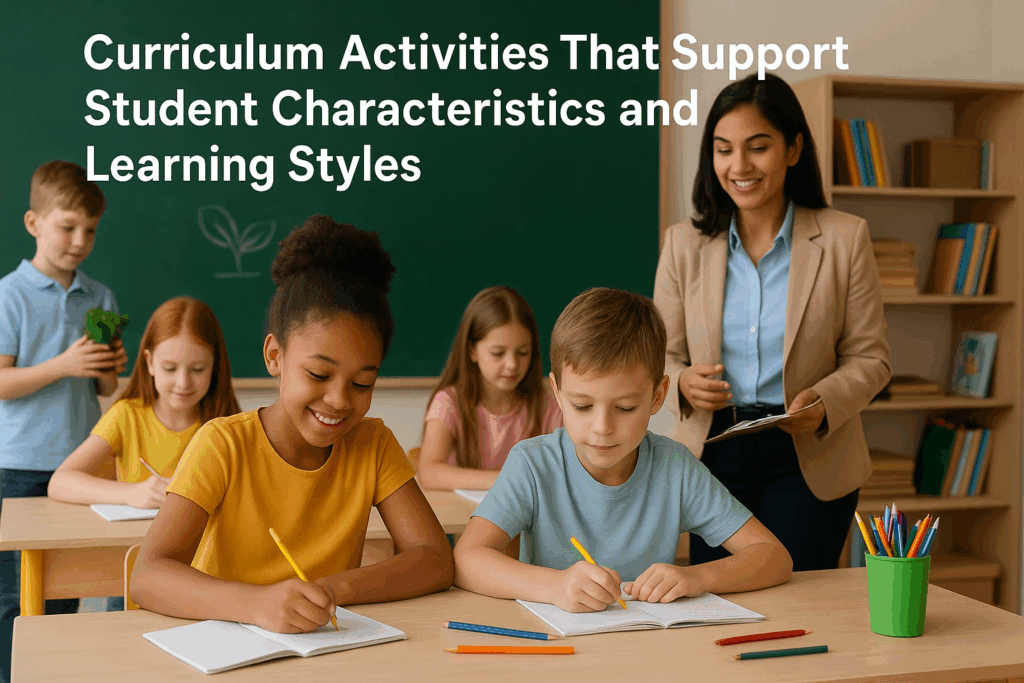
Every child learns in a different way. Some students are quick with numbers, while others shine in creative arts or storytelling. Recognizing these differences is what helps teachers design effective curriculum activities. But nowadays, many school focuses not only on academics but also on activities that nurture student characteristics, creativity, and overall well-being.
What this actually means is that an effective curriculum should be more than books. It should encompass practical, interesting, and reflective activities that cater to various learning styles. Let’s discuss some meaningful activities for student development and how they are related to the attributes every learner must cultivate.
Why Curriculum Activities Matter
Curriculum activities are not just added to routine lessons. They are bridges between the theoretical and the practical. For example, while a science text describes how plants grow, a gardening activity allows students to watch the process happen. Likewise, while English lessons teach grammar, engaging in literacy club activities allows children to use those skills in actual conversations and narratives. In short, activities make learning come alive. They honor multiple ways of learning, whether a child learns visually, hearing, doing, or reflectively. And more importantly, they shape children’s characteristics such as curiosity, teamwork, perseverance, and empathy.Developing Student Characteristics
All students enter the classroom with individual strengths and areas that require positive reinforcement. Qualities such as discipline, respect, concentration, and creativity don’t happen by themselves; they must be developed. Teachers utilize these activities to reinforce these traits. For instance:- Group work enhances cooperation and teamwork.
- Public speaking activities promote communication and confidence.
- Creative arts classes promote creativity and originality.
- Problem-solving games teach resilience and adaptability.
Mindfulness Activities for Emotional Development
In today’s busy world, children are constantly surrounded by distractions, be it gadgets, social media, or the need to perform. That is why mindfulness activities have found a place in contemporary education. These activities serve to make students slow down, concentrate, and become emotionally balanced. These activities in school involve meditation, breathing exercises, and reflection practices. Students who regularly practice these tend to exhibit:- Improved concentration in class
- Decreased stress and anxiety
- Enhanced emotional sensitivity
- Increased empathy for others
Literacy Club Activities to Inspire Creativity
Language is not grammar rules alone; it’s a means to convey thought, ideas, and emotions. Literacy club activities have a significant role to play within the curriculum. With sessions on storytelling, debates, creative writing workshops, and book clubs, students hone their communication abilities. They learn to think, voice opinions, and appreciate the joy of reading and writing. Literacy club activities are crafted to accommodate a variety of learning styles. Some learn better by reading and thinking alone, while others excel in discussions and presentations. By combining both, each student has a place where they can develop. Such activities also enhance vocabulary, understanding, and the art of public speaking that remains with students for life.Examples of Effective Curriculum Activities
The following are some everyday activities that teachers can incorporate to cater to different learning styles and student development:- Science Experiments: Easy hands-on experiments promote reasoning ability and facilitate understanding by visual learners of difficult concepts.
- Role Plays and Dramatics: Excellent for auditory and kinesthetic learners, the activities enhance confidence and group work.
- Art and Craft Sessions: Suitable for visual expression-oriented learners.
- Debates and Group Discussions: Develop critical thinking and communication, with an education on tolerance for alternative perspectives.
- Sports and Outdoor Games: Encourage discipline, teamwork, and physical well-being, and cater to kinesthetic learners.
- Mindfulness Circles: Brief periods of led meditation quiet the mind and enhance the concentration of students.
- Book Clubs and Writing Competitions: Literacy club activities that encourage reading, imagination, and systematic thinking.
Linking Learning Styles to Curriculum Activities
Each child learns in a unique way. Knowing learning styles informs instructors in how to pair activities with students’ requirements:- Visual learners are strengthened through diagrams, charts, and artwork projects.
- Auditory learners do best through storytelling, discussion, and presentations orally.
- Kinesthetic learners learn through hands-on experiments, athletics, and role plays.
- Reflective students benefit more from mindfulness activities such as journaling and meditation.
The Role of Parents and Teachers
These activities are potent, but they can be most effective when used in conjunction with parental and teacher support. Teachers develop and lead activities, while parents reinforce participation at home. For instance:- Parents can facilitate literacy club activities by reading with the children.
- Mindfulness activities, such as brief breathing exercises, can be done at home.
- Parents can celebrate small successes in curriculum activities, building confidence.