

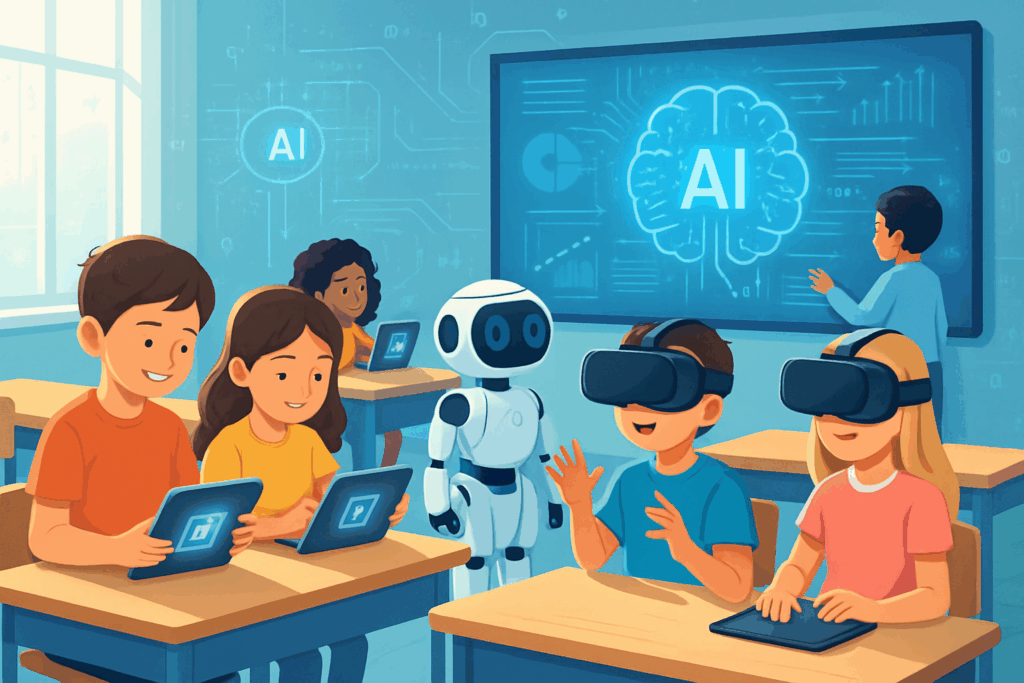
The way children learn was quite different from how they learn today. Textbooks, memorisation and chalkboards are no longer the only things used in classrooms. Artificial intelligence in schools is at the leading edge of the current shift in education. It is highly dependent on technology. AI is enabling instructors to concentrate more on their students and less on administrative duties by providing them with advanced evaluation tools, virtual assistants and individualised lesson plans.
Parents have major concerns about this change, such as how effectively AI enhances education. What does it constitute for young learners and most importantly, how can you make sure these adjustments are beneficial to your child? Let’s discuss it in detail.
Understanding Artificial Intelligence in Schools
Technology that is capable of information analysis, learning and decision making is referred to as artificial intelligence.
Artificial intelligence in education refers to systems that can adjust classes for each student’s speed and monitor progress in real time. AI also identifies areas that might require more support.
AI provides teachers with valuable insights into various learning styles, allowing them to approach every child differently. For instance, AI systems can recommend specific arithmetic exercises while still promoting reading success if a youngster struggles with math ideas but does well in reading.
In traditional classes, when one teacher had to balance the number of students with varying skills, this type of personalisation was practically impossible. Now, thanks to AI, education feels more student centered than ever.
Latest Trends in Educational Technology
To understand how AI fits into modern schooling. It helps to look at the latest trends in educational technology shaping classrooms.
- Adaptive Learning Platforms – Software that adjusts difficulty levels based on student performance.
- AI Powered Assessments – Real time quizzes that highlight not just what a student got wrong, but why.
- Virtual Tutors – Chatbots and AI driven assistants available 24/7 to answer student questions.
- Predictive Analytics – Systems that identify which students may need extra attention before grades drop.
- Gamification with AI – Interactive games, like lessons that keep students engaged while collecting performance data.
What this really means for parents is that your child’s education will increasingly be supported by technology that adapts, tracks and guides learning in a more personalised way.
AI Programs for High School Students
While younger children are introduced to AI through simple, playful tools, older students are diving deeper into practical applications. Today, many schools are offering AI programs for high school students that go beyond just using AI. They teach students how it works.
These programs often cover topics like:
- Introduction to coding and machine learning.
- Understanding ethical issues around AI use.
- Building small AI projects like chatbots or image recognition tools.
- Exploring how AI applies to careers in medicine, engineering or business.
Early exposure to AI principles helps schools prepare students for a future in which these talents will be highly valued. For students, this is career preparation as much as instruction.
The Role of Teachers in an AI-Driven Classroom
Whether AI will replace teachers is one of the main worries that parents frequently have. The truth is completely different. AI is a useful tool, not a replacement for teachers.
Teachers are still very important in the classroom. Instead of serving as the exclusive source of knowledge. They only take on the roles of advisors, mentors and facilitators. When AI handles tasks like grading or making practice worksheets, teachers have more time for interactions & creative instruction.
This balance ensures that while technology makes learning efficient, the human touch remains intact. Children still need encouragement, empathy and inspiration, qualities only teachers can provide.
Why Early Exposure to AI Matters
The earlier children are introduced to new technology, the more naturally they adapt. Just as today’s students are digital natives with smartphones and tablets, tomorrow’s learners will be AI natives.
Schools that integrate artificial intelligence in schools at the pre primary and primary level. This gives students a strong foundation. From interactive games that teach language to AI driven storybooks that adapt to a child’s vocabulary, even the youngest learners can benefit.
For example, parents looking for the best play schools in Tirupati or pre primary schools Tirupati can already find institutions introducing age-appropriate educational technology.
Building a Strong Foundation: Primary Education
By the time children move into primary school Tirupati, AI can play a bigger role in shaping how they learn. Personalised learning apps help teachers identify weak areas, while AI powered progress reports give parents detailed insights into how their child is performing.
The benefit here is balance. Children still learn through play, storytelling and group activities. But AI adds another layer of support, making sure no child is left behind.
Preparing for the Future: Secondary and High School
As students enter secondary education, AI tools get more advanced. AI dashboards in smart classrooms examine test scores, attendance and participation to provide teachers with a comprehensive view of student engagement.
In the meantime, high school AI courses instruct students in both developing and utilising AI technologies. As artificial intelligence becomes more and more significant to multinational corporations in terms of efficiency and innovation, this exposure is crucial.
Many educational establishments are integrating robots, coding and artificial intelligence into their curricula, including the ICSE schools in Tirupati. This implies that students are not just following the latest trends. But they are also ahead of the curve.
Addressing Concerns About AI in Education
Of course, parents often worry about screen time, data privacy and over reliance on technology. These are valid concerns. But when used thoughtfully, AI can enhance education without replacing essential human interaction.
Responsible schools ensure AI tools are age appropriate, safe and integrated with traditional teaching methods. Data privacy is prioritised and teachers are trained to strike the right balance between technology and personal guidance.
Life Skills Beyond Technology
AI is a powerful tool, but it is not the whole story. Schools must also nurture creativity, problem solving, teamwork and empathy. The best schools use AI as a support system.
This balance ensures that children grow into not just tech professionals but also well rounded individuals prepared for the real world.
Conclusion
Artificial intelligence in schools is not just a passing trend. It is shaping the future of education. The objective is to prepare kids for a world where technology and human talents come together, from high school AI programs to individualised learning.
It is important for parents to keep up with the most recent developments in educational technology. Whether you are exploring play schools in Tirupati, considering pre primary schools Tirupati, or planning for primary school Tirupati and beyond, choosing the right institution like Dr. Kishore’s Ratnam Gen Next Schools ensures your child gets the best of both worlds strong traditional teaching backed by smart AI driven tools. Education has always been about preparing the next generation for the future.