


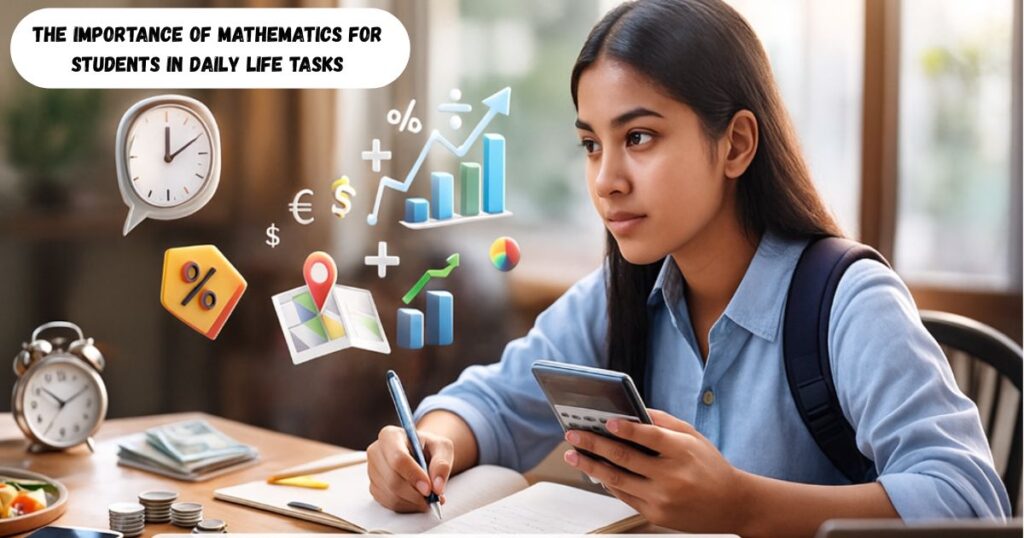
Many students ask the same question at some point: “Why do we need math in real life?” It’s a fair doubt. When you’re solving sums or learning formulas, it may not always feel connected to the real world. But the importance of mathematics goes far beyond classrooms and exams. Math shows up in our day to day lives in ways we don’t always notice.
Teachers often explain that math is not just a subject. It is a life skill. Once students understand how it works in real situations. They begin to see math as a tool that makes life easier and smarter. Let’s break this down in a simple way.
Math Helps You Make Everyday Decisions
Think about the choices you make every day.
- What time should you leave the house to reach school on time
- How much money should you save for something you want
- Which mobile plan gives better value
You use math in all these decisions, even if you don’t write it down. Math helps you compare, calculate, analyze and choose. When you understand numbers well, you make better decisions without confusion.
Money Management Becomes Easier
This is one of the clearest examples of the importance of mathematics in life. If you know basic math, you can easily:
- Calculate total expenses
- Manage pocket money
- Compare prices
- Understand discounts and offers
- Save money for future needs
Let’s say a shop offers a 30% discount. Someone who understands simple math instantly knows how much they’ll actually pay. Without math, it is easy to get fooled by misleading prices or confusing offers.
Math Improves Logical and Analytical Thinking
A major benefit that math gives is in the way it molds the brain. When students do math, they learn to:
- Be very careful in looking at problems
- Break them down into steps
- Think logically
- See whether answers make sense or not
These skills are not just for passing exams. They help in real life-if you are, say, planning a trip or fixing something at home or trying to understand news reports on TV or solving a misunderstanding.
Understanding and knowledge of mathematical properties, addition, subtraction, multiplication and division patterns clarify the thinking process of students to enable them to structure their thinking. This makes them apply any situation with confidence.
Technology, Gadgets, and Apps Run on Math
We use smartphones, calculators, social media apps and computers every single day. Behind every device and app, there is math.
- Games use math to calculate scores.
- Google Maps uses math to find the best route.
- Cameras use math to adjust focus.
- Banking apps use math to track transactions.
- Even when we don’t see it, mathematical logic keeps things running smoothly.
Understanding how important mathematics is will make students realize that they are constantly interacting with math, even in the things they enjoy.
Time Management Depends on Math
Many students struggle with completing homework, managing extracurricular activities and finding time to relax. Time management is basically math.
You estimate how long each task takes, what time you should start and how to divide your day. Once students learn to calculate time properly. They feel less stressed and more organized.
Math teaches how to plan ahead instead of rushing at the last moment.
Math Builds Confidence and Problem-Solving Skills
A student good with numbers is generally more confident in most aspects of life. He does not shy away from challenges. He has learned to face problems calmly and work his way through them, step by step.
Math teaches patience and focus as well as persistence, qualities helpful at every stage of life.
Math Is Important in All Careers
No matter what career a student chooses. The importance of mathematics remains strong. Here is how different fields use math:
- Doctors measure doses and analyze reports.
- Architects use geometry. They measure while designing buildings.
- Shopkeepers calculate change. They count stock.
- Engineers apply mathematics to solve real-world problems.
- Chefs adjust proportions in recipes.
- Athletes keep statistics to improve performance.
Even careers that seem unrelated to math, like fashion design or digital marketing, still require calculations, patterns and reasoning.
Math Makes Life More Systematic
While addressing a class on the importance of mathematics, structure or organization can hardly be overemphasized. Math is a structured discipline that teaches one to move from step one to step two and so on until the final solution is attained. This mode of thought unconsciously trains an individual to remain organized within his daily activities.
Be it placing books on a shelf at home, preparing a timetable for studies or any other activity, there has to be some order which math instills.
How Schools Help Students Appreciate Math
At Dr. Kishore’s Ratnam Schools, we concentrate on making the concepts of mathematics simple as well as meaningful. Our faculty members assist the students in relating any topic to real-life situations which makes the subject easy and interesting.
When students realize that mathematics is a part of daily life, they lose fear for the subject and automatically start using it consciously.
Final Thoughts
The importance of mathematics is not limited to books or exams. It plays a vital role in every aspect of life from simple to difficult tasks. Mathematics creates logical thinking among students to resolve any issues and make the right decision at the correct time. It gives them confidence and courage for all kinds of futures.
Dr. Kishore’s Ratnam Schools makes students do math outside the classroom context so that it becomes a skill they can depend on, inside and outside any classroom.
When students comprehend the logical structure of mathematics and freely apply properties to solutions, it makes them thinkers, planners, and builders of capacity.